
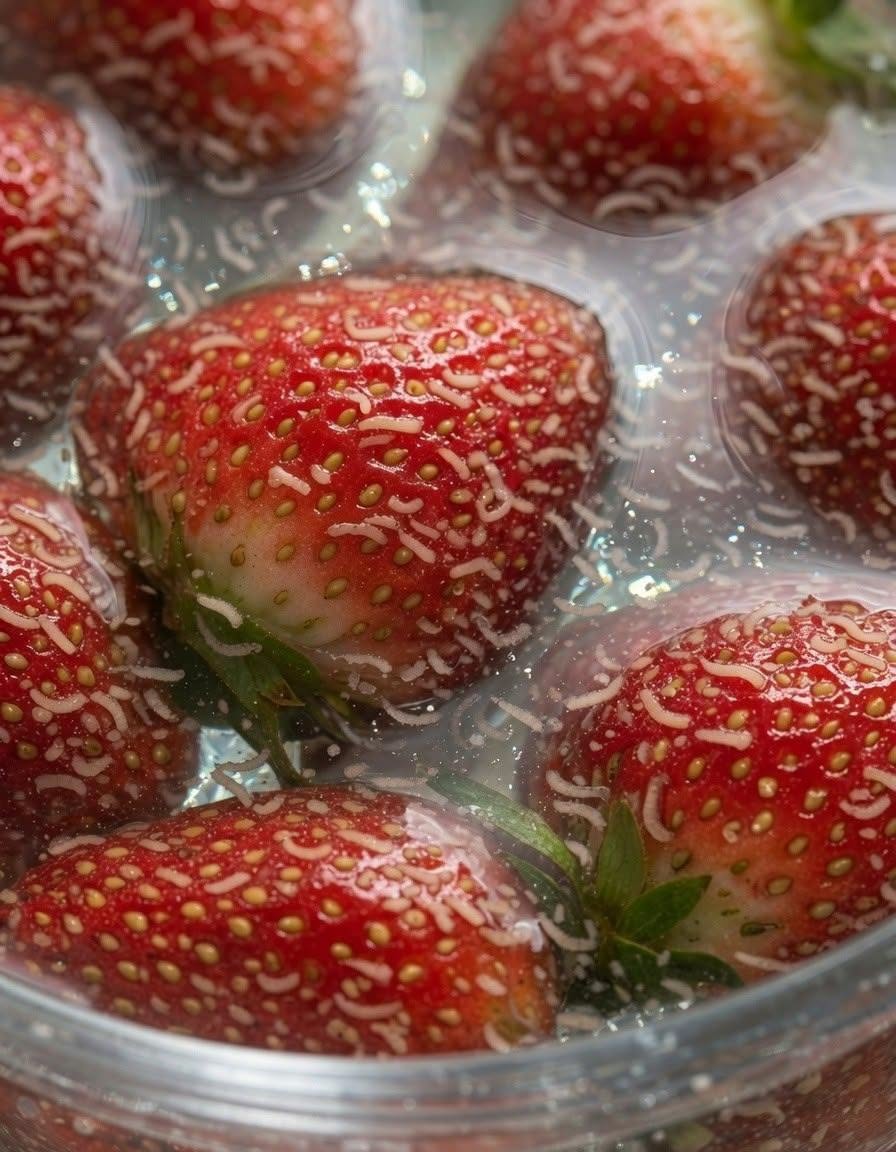
Seeing tiny white creatures moving in your fresh fruit can definitely be surprising—and let’s be honest, a little unsettling. You’re looking forward to enjoying those sweet, juicy strawberries, and suddenly you’re faced with something you never expected.
This topic has recently gained attention online, leaving many people wondering whether their favorite summer berries are still safe to eat. If you’ve experienced this, please take a slow, deep breath. You are not alone, and there is no need to panic. Let’s gently explore what may be happening inside your strawberries, the science behind the popular “salt water test,” and how you can prepare your fruit with confidence and peace of mind.
🔬 What Are the Tiny White Creatures in Strawberries?
If you’ve ever placed strawberries in salt water and noticed tiny white “worms” coming out, you’re not alone. These small creatures are usually larvae (maggots) of certain fruit flies, not actual worms.
They are extremely small—often about 1 to 3 millimeters long—and because they are pale and almost transparent, they can be very hard to see while they are inside the berry.
How They Get There:
The larvae develop within the fruit because the soft, sugary interior provides an ideal food source. A female fruit fly lays her eggs just beneath the skin of the berry, and once the eggs hatch, the larvae remain inside the fruit while they feed and grow. Warm, humid conditions allow this process to happen quite quickly.
The Insect Responsible: Spotted Wing Drosophila
The insect commonly responsible for this is called the spotted wing drosophila (SWD). Unlike many fruit flies that prefer fruit that is already rotting, this species often targets healthy, ripening fruit still on the plant.
Key Characteristics:
Adult SWD flies are tiny insects with red eyes and light-colored bodies
Male flies have distinct dark spots on their wings (hence the name)
Female flies have a specialized egg-laying organ that allows them to pierce the skin of firm fruit and deposit eggs inside
They can affect crops such as strawberries, blueberries, cherries, and raspberries
🧂 Why Salt Water Makes the Larvae Come Out
lire la suite sur la page suivante >>
