
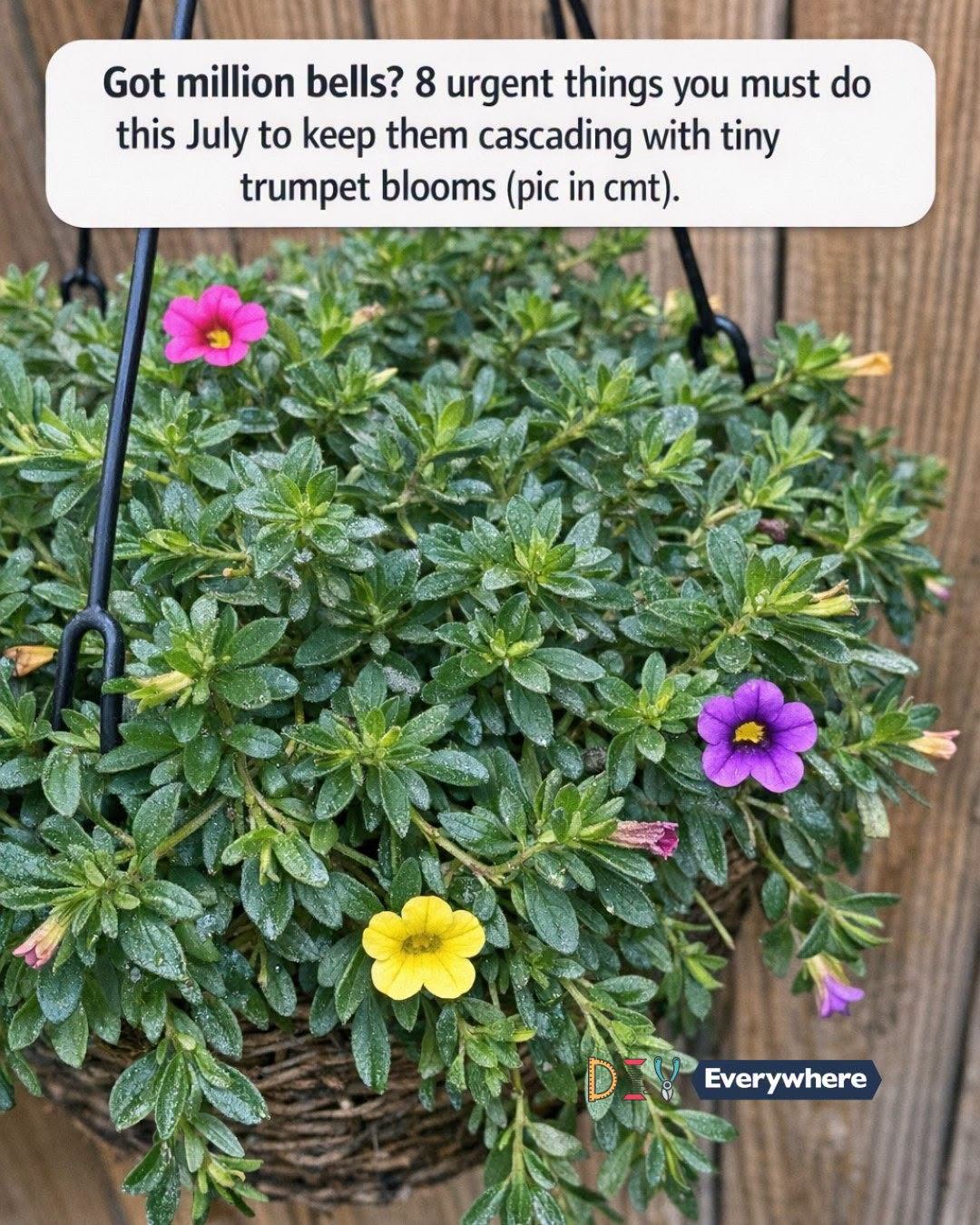
If your million bells suddenly look a little tired in July, you are definitely not alone. By this point in summer, my hanging baskets and patio pots have usually gone from absolutely showy in June to a little leggy, a little sticky, and somehow both overgrown and underperforming at the same time. Calibrachoa can bloom like crazy, but in the hottest stretch of the season they also ask for a bit more attention if you want that full, spilling, tiny-trumpet-flower look to keep going.
Over the years, I’ve learned that July is the month that really determines whether million bells cruise beautifully into late summer or fizzle out by the end of the month. The good news is that the fix is usually not complicated. A few timely steps with water, fertilizer, trimming, and pest checks can make a huge difference fast. Here’s exactly what I do in July to keep my million bells blooming hard and cascading over the sides of containers instead of stalling out.
1. Recheck your watering routine for peak summer heat
In July, the watering schedule that worked in May or even June often stops being enough. Million bells in containers dry out quickly, especially in hanging baskets, coco liners, window boxes, and dark-colored pots that heat up in afternoon sun. On weeks when daytime temperatures hit 85 to 95 degrees, I check mine every morning before work and again in the early evening if the weather has been especially hot or windy.
The goal is evenly moist soil, not soggy soil. I water until I see it run from the drainage holes, then I stop. For a 12-inch hanging basket, that can be close to 1 quart of water, sometimes more in a heat wave. If the soil has become bone dry and starts pulling away from the sides of the pot, I soak it slowly in two rounds, waiting 10 to 15 minutes between each round so the root ball actually rehydrates instead of letting water rush straight through.
One quick trick I rely on: lift the pot if you can. A basket that feels surprisingly light usually needs water, while one that still feels heavy can wait. This has saved me from both overwatering and underwatering more times than I can count.
2. Feed weekly with a bloom-friendly liquid fertilizer
Million bells are heavy feeders. If they are flowering nonstop, they are using nutrients nonstop too. By July, the potting mix in containers is often depleted, and that is when blooming slows, foliage pales, and the plant starts looking thin. I like using a liquid fertilizer once a week at half strength, especially one formulated for flowering annuals.
Look for something close to a balanced or bloom-supportive ratio, such as 10-10-10, 15-30-15, or 20-20-20, depending on what you already have and how your plants look. If I’m feeding weekly, I usually dilute to half the label rate to avoid salt buildup. For example, if the label says 1 tablespoon per gallon, I use 1 1/2 teaspoons to 2 teaspoons per gallon instead.
If your million bells are still green but not blooming well, missed feeding is often the reason. I have absolutely done this in busy weeks, and the plants let me know fast. Within 7 to 10 days of getting back on a regular feeding schedule, I usually see a flush of fresh buds.
3. Flush the potting soil to remove fertilizer salts
This sounds contradictory right after feeding advice, but it matters. When you water and fertilize containers repeatedly, mineral salts can build up in the potting mix. That buildup can interfere with nutrient uptake and leave plants looking stressed even when you’re technically “doing everything right.” Yellowing leaves, crispy tips, and weak flowering can all point to this.
About once in July, especially if I have been feeding regularly, I flush each container thoroughly with plain water. I run enough water through the pot to equal roughly twice the volume of the container. For a 10-inch pot, that may mean 1 to 2 gallons. The idea is to rinse excess salts out through the drainage holes.
Do this in the morning so the plant is not sitting waterlogged overnight. Then wait a day or two before resuming fertilizer. This reset can perk up million bells more than people expect.
4. Give leggy plants a midsummer haircut
If your plant is blooming mostly at the ends and looks bare or stringy near the crown, July is the perfect time for a trim. I know it feels wrong to cut back a flowering plant in the middle of summer, but calibrachoa responds really well to a light haircut. I usually trim stems back by about one-third, and on very overgrown baskets I may go closer to one-half.
Use clean scissors or hand pruners and shape the plant evenly all around. On a trailing plant with 12-inch stems, I might take them back to 8 inches. You do lose some blooms that day, but in my experience the plant rebounds with thicker growth and more even flowering within 10 to 14 days, especially if you water and feed right after the trim.
This is one of those jobs I tend to put off because life gets busy, and every single time I finally do it, I wish I had done it a week sooner.
5. Deadhead selectively, even though million bells are called self-cleaning
Million bells are often sold as self-cleaning, and compared to petunias, they usually are. But by July, I still find that they benefit from a quick cleanup. Dried blooms, seed pods, and sticky clusters can build up, especially after rainstorms or stretches of humid weather. When that happens, new buds can get shaded or trapped.lire la suite sur la page suivante >>
