
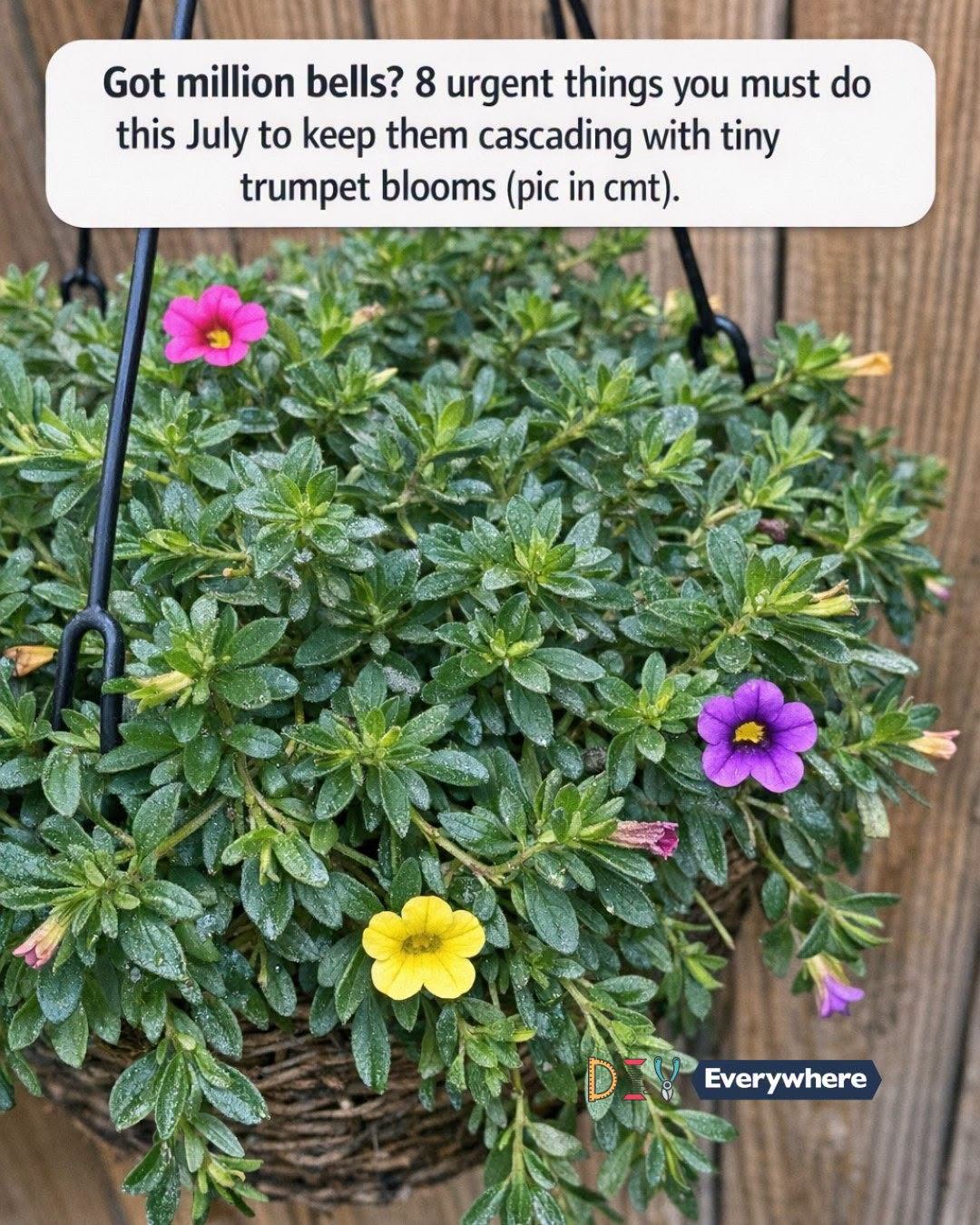
I don’t sit there and deadhead every tiny flower one by one. Instead, I spend 2 to 5 minutes per pot pinching off spent clusters, removing any mushy stems, and clearing the crown of debris. If a stem has gone mostly spent, I cut back to a healthy set of leaves rather than fussing over each bloom.
This is especially helpful if your basket is near a porch roof, where less rain washes the plant naturally, or in a spot with poor airflow where faded blooms tend to cling.
6. Check the soil pH if leaves are yellowing between the veins
One of the most common July problems with calibrachoa is yellowing leaves with greener veins, especially on new growth. That often points to iron deficiency, and with million bells, the issue is frequently tied to pH rather than a lack of fertilizer overall. They generally prefer a slightly acidic growing medium, and if the pH drifts too high, they struggle to take up iron efficiently.
If this is happening, don’t just keep adding more all-purpose fertilizer and hope for the best. Use a simple pH test for container soil if you can. A pH around 5.5 to 6.5 is usually a better range for calibrachoa. If your water is hard or alkaline, that can gradually push the pH upward.
I’ve had the best luck correcting this with an iron supplement labeled for plants, often chelated iron, plus a more consistent fertilizer routine. If the issue is advanced, the plant may need 1 to 3 weeks to green back up. New growth is your best indicator that things are improving.
7. Inspect for aphids, spider mites, and budworms before damage spreads
July pests can sneak up fast, especially when the plant is dense and spilling over the sides of the pot. I check the undersides of leaves, growing tips, and buds at least once a week. Aphids show up as clusters of tiny insects on soft growth. Spider mites are harder to see, but fine webbing and a dusty, stippled leaf surface are clues. Budworms can chew buds and flowers overnight, leaving ragged petals and frustratingly few open blooms.
If I catch aphids early, a firm spray of water in the morning often knocks them back. For larger issues, insecticidal soap can help, but I make sure to follow the label and avoid spraying in the hottest part of the day. Spider mites usually get worse in hot, dry weather, so increasing humidity around the plant is less practical outdoors than simply washing foliage and treating quickly.
With budworms, hand-picking at dusk sometimes works if the infestation is light. If flowers look chewed but you can’t spot the culprit at first glance, check in the evening with a flashlight. I learned that one the annoying way after blaming watering for a full week.
8. Make sure the plant is still getting enough direct sun
Million bells generally bloom best with at least 6 hours of direct sun, and 8 hours is often even better if you can keep up with watering. But here’s the July wrinkle: the sun angle changes and nearby plants grow. A container that had perfect exposure in early summer can end up shaded by a tomato cage, taller annuals, or a shrub that has filled out.
If blooming has slowed but foliage still looks decent, I always step back and look at the whole area at different times of day. Sometimes the problem is as simple as a basket losing 2 or 3 hours of midday light. Moving it even a few feet can help.
On my patio, I’ve had to rotate pots or swap positions entirely by mid-July. It feels a little fussy, but if I can trade a too-shady spot for one with morning sun and open airflow, the improvement is usually worth it.
9. Improve airflow to prevent midsummer decline
When million bells are packed tightly with other annuals or pushed into a humid corner, the center can stay damp too long after watering or summer storms. That raises the chances of fungal problems and general decline. Good airflow matters more in July than it did in spring because plants are fuller, temperatures are higher, and the nights can stay muggy.
Try to keep at least a few inches of space between crowded containers. If million bells are mixed into a combo planter with sweet potato vine, coleus, or another vigorous spiller, trim those neighbors back if they are smothering the calibrachoa. I’ve had sweet potato vine try to stage a complete takeover more than once.
If the crown of the plant looks dark, congested, or constantly damp, thinning and trimming can make a real difference. Air moving through the plant helps foliage dry faster and keeps new buds healthier.
10. Remove any stems that have turned brown, mushy, or bare
Not every stem is worth saving in July. Heat stress, root stress, and old growth can leave parts of the plant brown, leafless, or limp. Those stems do not usually bounce back well, and leaving them in place makes the whole container look tired. I cut dead or declining stems all the way back to healthy green growth.
Be a little ruthless here. If 20 to 25 percent of the basket looks bad, clean it out. The plant often looks temporarily smaller but much fresher. Then feed lightly and keep the watering steady so the healthy sections can fill back in.
This is one of my favorite quick refresh jobs before company comes over, because a 5-minute cleanup can make a porch planter look intentionally maintained instead of forgotten.
11. Check whether the container is simply too crowded or rootbound
By July, a vigorous million bells can outgrow a small nursery pot fast. If water runs straight through, the plant wilts within hours, and roots are circling densely at the bottom, it may be rootbound. A plant that is rootbound can still flower, but it becomes much harder to keep hydrated and fed consistently during hot weather.
If you gently slide the root ball out and see thick white roots wrapping around the outside with very little loose mix left, move it up one pot size. Usually 2 inches wider is enough, such as from a 10-inch pot to a 12-inch pot. Use fresh, well-draining potting mix rather than garden soil.
If repotting in midsummer feels daunting, I get it. I don’t always want to tackle it either. But if you have a plant that wilts by 2 p.m. every day no matter what, this can be the real fix.
12. Set up a simple July maintenance rhythm you can actually keep
The biggest secret to keeping million bells cascading isn’t one miracle product. It’s consistency. In my house, if a plant task is too complicated, it gets skipped during busy workweeks. So I keep a very simple July routine: quick morning water check daily, fertilizer once a week, pest inspection every weekend, and a haircut or cleanup as needed every 10 to 14 days.
If you want an easy checklist, here’s a realistic one: Monday or Tuesday, feed. Wednesday, check for yellowing and sun exposure. Saturday morning, inspect for pests and trim spent growth. Every day above 90 degrees, check moisture twice. That’s it. With that level of attention, million bells usually stay full and flower-heavy well into August and often beyond.
And honestly, that’s why I keep planting them. They look lush and expensive, but once you understand their midsummer needs, they’re very manageable—even for those of us squeezing plant care in before work with coffee in hand.
